Have you ever baked cookies that turned out too crispy, too cakey, or just not right? 😩
You are not alone. The secret behind the perfect cookie lies in its texture, and that texture is controlled by ingredient ratios, mixing methods, and baking science.
Even a slight change like an extra spoon of flour or swapping brown sugar for white can completely shift your cookie’s texture profile from chewy to crunchy. 🧪
At The Baking How, we’ve spent months analyzing how ingredients interact (like fat-to-flour ratios, sugar types, and oven temperature) through our troubleshooting guides:
👉 Why Are My Cookies Too Soft?
👉 Why Is My Cookie Dough Too Sticky?
Through that journey, we realized bakers needed something practical: a simple way to predict cookie texture before baking.
The Baking How Cookie Texture Calculator is an interactive tool that predicts how your ingredients affect cookie texture.
It analyzes flour, sugar, fat, and egg ratios to determine whether your cookies will be chewy, crispy, or soft — before baking.
Powered by real baking science and 17 years of testing, this is the web’s first cookie texture prediction calculator.
Whether you want your cookies extra chewy, crispy-edged, or perfectly balanced, this cookie ingredient ratio tool turns your recipe experiments into science-backed precision. 🎯
So, before you grab that mixing bowl let’s make your next batch predictably perfect.
🧮 Try the Free Cookie Texture Calculator
Looking to find out whether your cookie dough will bake up chewy, crispy, soft, or cakey? 🕵️♀️
Use our free Cookie Texture Calculator — the first tool designed to predict your cookie’s texture before you even bake!
Simply enter your ingredient setup and let the calculator do the magic 👇
🔧 How to Use It
1️⃣ Input your recipe details — flour type, sugar ratio, butter form, and eggs.
2️⃣ Check your Predicted Texture — instantly see whether your dough will turn out chewy, soft, or crispy.
3️⃣ Read the Expert Tip — learn exactly how to fix or fine-tune your texture.
4️⃣ Select Your Desired Texture — want chewier cookies or crispier edges? The tool shows the ideal ingredient setup for that result.
👉 “Ready to bake your perfect cookie? Use the free Cookie Texture Calculator below to predict and perfect your next batch.”
🍪 Cookie Texture Calculator
Looking for ingredient conversions or scaling help?
Check out our Quick Baking Converter Tool for precise gram-to-cup and temperature conversions.
👩🍳 The Story Behind the Cookie Texture Calculator
Every great baking idea starts with a single question and ours was simple:
“Can we predict a cookie’s texture before it goes in the oven?” 🤔
At The Baking How, our journey began with one clear goal — to help home bakers fix their cookie challenges. Over the years, we have published dozens of science-backed guides like:
🍪 Why Are My Cookies Too Flat?
🔥 Why Do Cookies Burn on the Bottom?
🥣 Why Is My Cookie Dough Too Sticky?
Each post taught us something new about what truly defines a cookie’s personality — its texture. But as our community grew, one question kept popping up in comments and emails:
“Saqlain, I understand how to fix my cookies after baking…
but is there a way to predict how they’ll turn out beforehand?”
That was the moment 💡 — the realization that we could merge 17 years of real-world baking experience with modern data-driven tools to create something no one else had: a cookie texture calculator that uses ingredient ratios and baking science to forecast texture outcomes in real time.
What started as a kitchen experiment soon became a full research project — testing dozens of recipes, analyzing ingredient combinations, and mapping how flour, butter, sugar, and eggs influence texture at a molecular level. 🧪
The result? A first-of-its-kind cookie baking innovation — a predictive cookie texture tool that turns every baker into a texture scientist.
🧠 Why This Cookie Texture Calculator Is Unique
There are plenty of recipe tools online — but none that truly understand cookies the way bakers do.
The Cookie Texture Calculator by The Baking How is the first tool built entirely around baking science, not guesswork.
🔬 Backed by Real Baking Science
Instead of pulling random recipe data, this calculator uses ingredient ratio logic — a method drawn from our 17 years of professional baking experience and testing dozens of cookie formulas.
It analyzes how flour, fat, sugar, eggs, and leavening agents interact to predict the outcome you’ll actually taste.
💡 Designed for Bakers, Not Coders
We created this tool to be simple enough for home bakers yet accurate enough for professionals.
You just enter your ingredient amounts, and it predicts whether your batch will turn out chewy, crispy, cakey, or soft — instantly.
No spreadsheets, no guesswork — just clear insights.
🧭 Backed by Research & Real Feedback
The Baking How team spent months refining the ratios and logic behind this tool, powered by insights from our most-read cookie guides like:
- Why Do Cookies Spread Too Much?
- What Do Eggs Do in Cookies?
- Best Flour for Cookies
Each article taught us something new — and all that knowledge now lives inside this calculator.
🌍 A Tool Built for Every Baker
Whether you’re in a home kitchen or running a bakery, this calculator adapts to your recipe.
It’s more than a calculator — it’s a teaching companion that helps you understand why your cookies turn out the way they do.
🔍 How the Cookie Texture Calculator Works
Ever wondered how this cookie formula calculator knows what texture your cookies will have before you even bake? 🍪
It’s not magic — it’s baking science + data-driven ratios at work.
At The Baking How, we studied dozens of cookie recipes, analyzed ingredient proportions, and tested how small changes affect texture.
From flour protein levels to sugar ratios and butter form, every input in the calculator is mapped to real-world baking results.
🧠 The Logic Behind the Tool
Here’s how the cookie ingredient ratio tool actually works under the hood:
1️⃣ You Input Ingredients — such as flour type, sugar mix, and butter condition.
2️⃣ The Calculator Analyzes Ratios — it compares the balance of wet to dry ingredients, sugar types, and fat content.
3️⃣ It Predicts Texture — the system checks your ratios against our baking database and shows what texture you’ll likely get (chewy, crispy, soft, or cakey).
4️⃣ You Get a Tip + Fix — a quick pro suggestion to adjust your dough if needed.
5️⃣ You Choose Your Desired Texture — and see exact ingredient recommendations to reach it perfectly.
💡 In short:
Your recipe’s ingredient ratios = your cookie texture.
Our calculator simply makes that relationship visible and easy to tweak.
🧪 Ingredient Science: What Affects Cookie Texture
If you have ever asked “Why did my cookies turn flat?” or “How do I make them chewier?” — the answer is always in the ingredients.
This is where the cookie ingredient ratio tool gets its power. Every ingredient in your dough changes the chemistry of texture — sometimes in surprising ways.
Let’s break it down 🔬
🥖 1. Flour Type & Protein Content
Your flour is the backbone of the cookie texture.
- Bread flour → more protein = stronger gluten = chewier cookies
- All-purpose flour → balanced gluten = soft and sturdy cookies
- Cake flour → less protein = light, cakey texture
💡 Tip: Too much flour can make cookies dry or hard, while too little makes them flat.
👉 Dive deeper: As explained by King Arthur Baking’s test kitchen, the protein level in flour directly affects how chewy or crisp cookies become.
🍬 2. Sugar Ratio & Type
Sugar controls more than sweetness — it shapes the texture, color, and spread.
- White sugar → more spread, crispier edges
- Brown sugar → moisture retention, chewy texture
- Powdered sugar → delicate, tender bite
That’s why the cookie ratio calculator considers your sugar mix before predicting texture.
👉 Learn more: How Brown Sugar Changes Cookies
🧈 3. Butter or Fat Choice
Fat determines how your dough melts, spreads, and feels.
- Melted butter → flatter, chewier cookies
- Softened butter → balanced, classic texture
- Shortening or oil → less spread, cakier results
Even the temperature of your butter can make or break a batch — and our cookie texture calculator accounts for it.
👉 Read: What does butter do in cookies?
🥚 4. Eggs & Moisture Balance
Eggs are the binders and balancers in cookie structure.
- Egg whites add dryness and structure
- Egg yolks bring richness and chewiness
- Too few eggs → dry or crumbly texture
- Too many → cake-like, soft cookies
👉 Explore: What Do Eggs Do in Cookies
❄️ 5. Chilling the Dough
Chilling lets the flour hydrate and the fat solidify — meaning:
- Less spread
- More chew
- Deeper flavor
Even a 30-minute chill can completely change the result.
👉 Discover why: Why Chill Cookie Dough
🧩 In short: Cookie texture isn’t guesswork — it’s science.
That’s why our cookie texture calculator analyzes your ingredient ratios instead of random recipes.
🧾 Cookie Texture Ingredient Comparison Chart
| 🧪 Ingredient | 🍪 Affects Texture By | 🔥 Makes Cookies Crispier | 🍯 Makes Cookies Chewier | ☁️ Makes Cookies Softer/Thicker | 💡 Quick Tip |
|---|---|---|---|---|---|
| Flour (Protein Level) | Gluten formation | Use bread flour → more gluten | Use all-purpose flour | Use cake flour → less gluten | Higher protein = more chew |
| Sugar Type | Moisture + caramelization | More white sugar | More brown sugar | Mix both for balanced texture | Brown sugar adds moisture & chew |
| Butter/Fat Type | Spread + mouthfeel | Melted butter spreads more | Softened butter adds chew | Shortening or chilled butter adds thickness | Chill dough for less spread |
| Eggs | Structure + moisture | Fewer eggs = thinner, crisper | Add extra yolk for chew | Whole egg = soft and balanced | Yolks = richness, whites = crisp |
| Baking Soda vs. Baking Powder | Leavening reaction | Baking soda = more spread | – | Baking powder = puffier cookies | Soda for crisp, powder for lift |
| Chilling Dough | Fat solidification | Skip chilling = thinner cookies | – | Chill 30–60 mins = thicker, softer | Chill longer for better control |
| Oven Temp & Time | Browning & spread | Higher temp = crisp edges | Medium temp = chewy center | Lower temp = soft cookies | Adjust time 1–2 mins for control |
🎯 Desired Texture Guide — Get the Perfect Texture You Want
Each cookie lover has a favorite texture — whether it’s crispy edges, chewy centers, or soft and cakey perfection.
Use this quick guide to learn how to adjust ingredients for your desired outcome and then test it in the Cookie Texture Calculator.
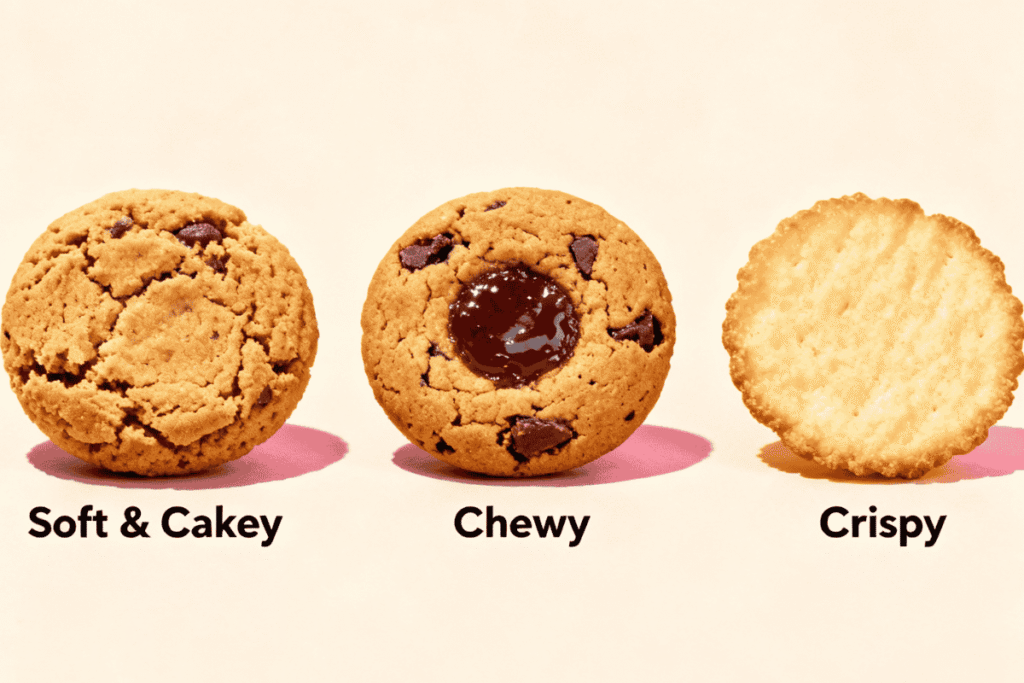
🍯 Chewy Cookies
- Use more brown sugar than white
- Add an extra egg yolk for moisture
- Slightly underbake (1–2 minutes less)
💡 Pro Tip: Bake at 350°F (175°C) and let cookies cool on the tray for 5 minutes for the perfect chewy center.
🔥 Crispy Cookies
- Use more white sugar and reduce eggs slightly
- Melt butter completely before mixing
- Bake at a higher temperature (375°F / 190°C) for golden, crisp edges
💡 Pro Tip: Cool cookies fully on a wire rack for maximum crunch.
☁️ Soft Cookies
- Use cake flour or mix all-purpose flour with cornstarch
- Add a pinch of baking powder
- Avoid overmixing to keep dough tender
💡 Pro Tip: Bake at 325°F (163°C) and store cookies with a bread slice to maintain softness.
🧁 Cakey Cookies
- Add an extra egg or a bit more baking powder
- Use less butter and slightly more flour
- Chill dough before baking for a puffier texture
💡 Pro Tip: Perfect for sugar cookies or pumpkin cookies where lift matters.
👉 Want to make your cookies exactly how you like them?
Use our Cookie Texture Calculator to experiment with ingredient ratios and instantly see how changes affect texture.
🧁 Cookie Texture Troubleshooting (Fix Problems Fast)
Sometimes your cookies don’t come out as planned — they might be too flat, dry, cakey, or overly soft. Let’s fix those problems fast!
Use this quick guide and our Cookie Texture Calculator to identify what went wrong and how to adjust your recipe next time.
Why Cookies Turn Flat
Possible causes:
- Too much butter or not enough flour
- Dough too warm before baking
- Baking sheet not cooled between batches
Quick Fix:
👉 Chill the dough for 30 minutes and add 1–2 tablespoons of extra flour.
Learn More: Why Do Cookies Spread Too Much?
Each cookie lover has a favorite texture — whether it’s crispy edges, chewy centers, or soft and cakey perfection.
Use this quick guide to learn how to adjust ingredients for your desired outcome and then test it in the Cookie Texture Calculator.
Why Cookies Are Dry or Hard
Possible causes:
- Overbaked cookies
- Too much flour or too little fat/sugar
- Not enough moisture-binding ingredients (like brown sugar or egg yolk)
Quick Fix:
👉 Reduce baking time by 1–2 minutes and switch to brown sugar for extra softness.
💡 Pro Tip: Store cookies with a slice of bread to re-soften them overnight. - Learn More about why are my cookies hard?
Why Cookies Are Cakey
Possible causes:
- Too much egg or leavening agent (baking soda/powder)
- Low butter-to-flour ratio
Quick Fix:
👉 Use only 1 egg or reduce baking soda by ¼ teaspoon.
🧠 Science Insight: Eggs and baking powder trap extra air, creating a cake-like structure instead of chewiness.
Why Cookies Are Too Soft
Possible causes:
- Too much brown sugar or butter
- Underbaked centers
Quick Fix:
👉 Add 1 tablespoon of flour per cup or bake 1–2 minutes longer.
🔗 Read More: Why Are My Cookies Too Soft?
🧁 Cookie Texture Troubleshooting Chart (Fix Problems Fast)
🎛️ Try Our Interactive Tool:
Find out exactly why your cookies turned flat, hard, cakey, or soft — and how to fix them fast!
❓ FAQs – Your Cookie Texture Questions, Answered
1. How do I make cookies chewier?
To make cookies chewier, use all-purpose flour, add an extra egg yolk, and replace part of the white sugar with brown sugar for added moisture.
Chilling the dough before baking also helps control spread and lock in chewiness.
2. What makes cookies crispy instead of soft?
Crispy cookies come from a higher ratio of white sugar, melted butter, and slightly longer baking time at a higher temperature.
For softer cookies, lower the temperature and use more brown sugar or cake flour.
3. How can I fix flat cookies?
Flat cookies often happen due to too much butter, too little flour, or skipping dough chilling.
You can use the Cookie Texture Calculator to check ingredient balance and prevent spreading next time.
4. What ingredients affect cookie texture the most?
The biggest texture changers are flour type, sugar ratio, fat source, eggs, and leavening agents.
Each one alters how your cookies spread, rise, and feel when bitten.
5. Can I use this calculator for brownies or cakes?
Currently, the tool is optimized for cookies only, but The Baking How team is working on expanding it into a Brownie Texture Calculator and a Cake Ratio Tool soon.
Stay tuned for updates on our Tools Page!
🍪 Final Thoughts: Start Predicting Your Perfect Cookie Today
Cookies are more than just treats — they’re a delicious balance of science, art, and a pinch of magic.
And now, with The Baking How’s Cookie Texture Calculator, you can take control of that science to bake your perfect texture every single time.
Whether you dream of chewy centers, crispy edges, or soft, melt-in-your-mouth cookies — this free tool helps you understand your ingredients, predict your results, and fine-tune your recipe like a pro.
✨ Ready to find your perfect texture?
Try the Cookie Texture Calculator now — and turn every batch into bakery-quality perfection.