🍪 Cups ↔ Grams Converter
Ingredient-Specific Baking Conversion Tool
Cups to Grams Converter (Ingredient-Specific Baking Tool)
Baking is a science and every gram counts. If you’ve ever wondered why your cookies turn out dense one day and perfectly chewy the next, the culprit is often your measurements. A single extra tablespoon of flour or sugar can change everything from texture to taste.
That’s why understanding the difference between cups and grams is essential for every home baker. While cups measure volume, grams measure weight and those two don’t always match up. For example, 1 cup of flour weighs around 120 grams, but 1 cup of sugar weighs nearly 200 grams. Different ingredients have different densities, completely different results.
As someone who’s spent over 17 years in the baking industry, I’ve seen firsthand how measurement accuracy separates a good baker from a great one. Whether I was developing recipes for bakeries or teaching beginners the art of balance, one rule never changed: precise measurements equal consistent results.
To make this easier for every baker, we’ve built a free, ingredient-specific Cups to Grams Converter designed to instantly give you the exact conversion for over 200 common baking ingredients. No more guessing, no more flat cookies — just accurate, science-backed conversions that help you bake with confidence. 🍪
What Is the Difference Between Cups and Grams?
If you’ve ever wondered how many grams are in a cup, the short answer is it depends on what you’re measuring. That’s because cups measure volume, while grams measure weight.
Think of it like this: a cup tells you how much space an ingredient takes up, but grams tell you how heavy that ingredient actually is. And in baking, those two things can vary a lot depending on texture and density.
For example:
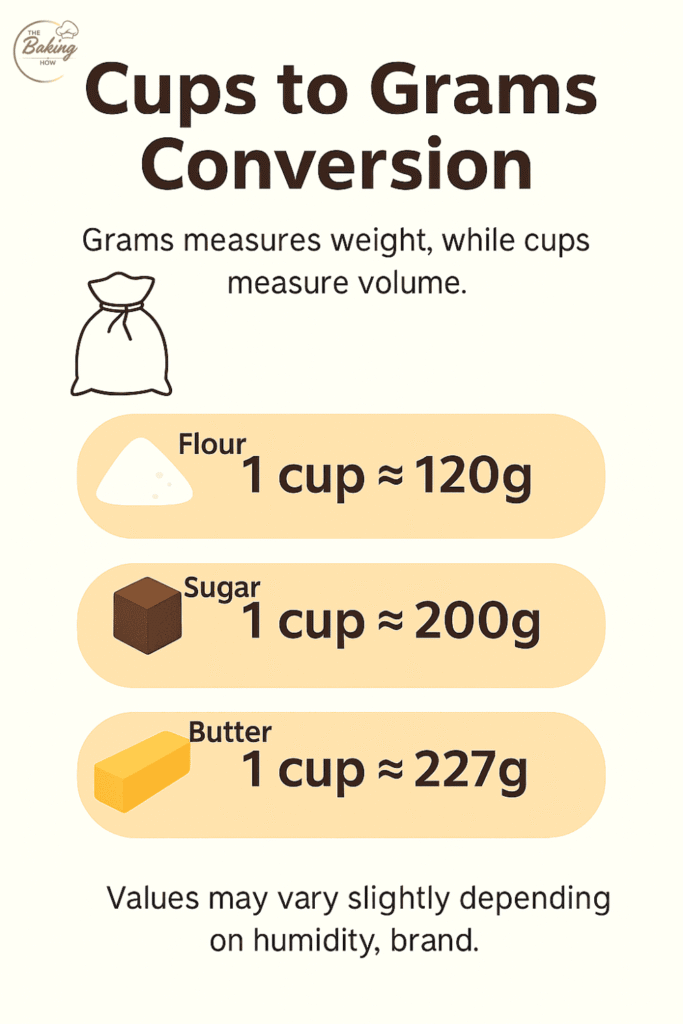
- 🌾 1 cup of all-purpose flour ≈ 120 grams
- 🍬 1 cup of granulated sugar ≈ 200 grams
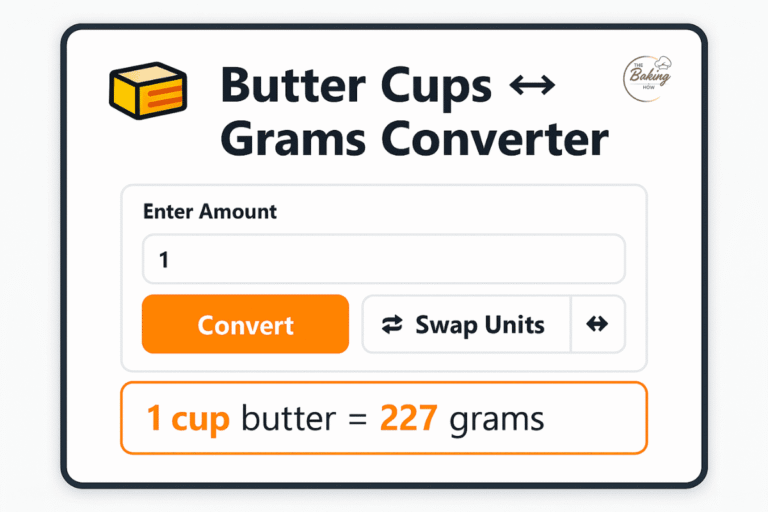
- 🧈 1 cup of butter ≈ 227 grams
Even though they each fill the same measuring cup, the weights are completely different because flour is light and airy, sugar is dense, and butter is heavier and contains fat.
Why Converting Cups to Grams Matters in Baking
Baking isn’t just creativity — it’s chemistry in your kitchen. Every recipe you bake is a careful balance of ratios, moisture, and structure. That’s why even a tiny measuring mistake can completely change the outcome.
As I often tell my students:
“One extra tablespoon of flour can ruin a perfect batch of cookies.”
When you scoop with cups, you’re measuring volume, and that can vary a lot depending on how the ingredient settles, how tightly it’s packed, or even the brand you use. But when you measure by weight, you’re using precision and consistency — the two pillars of professional baking.
In my 17 years of baking experience, I’ve seen how professionals rely almost exclusively on grams because it removes all the guesswork. A digital scale doesn’t care if your flour is sifted or compacted — 120 grams is 120 grams every time.
Here’s how different the same “1 cup” can actually be depending on ingredient density:
| Ingredient | 1 Cup (Approx.) | Weight (Grams) |
| 🌾 All-Purpose Flour | Light and airy | 120 g |
| 🍬 Granulated Sugar | Dense crystals | 200 g |
| 🧈 Butter | Fat-based solid | 227 g |
| 🥥 Shredded Coconut | Fluffy, low-density | 85 g |
These variations are why recipes that rely only on cup measurements can be unpredictable especially in delicate bakes like cookies, macarons, or pastries.
Using gram-based conversions ensures your ingredients maintain the right ratios and your baked goods turn out consistent, batch after batch. It’s not just about conversion — it’s about accuracy, reliability, and mastery in baking.
That’s why professional bakers and experienced home bakers too — rely on gram-based measurements for accuracy. When you measure by volume (cups), factors like how tightly you pack the ingredient or even the humidity in the air can throw off your recipe. Measuring in grams removes that guesswork and keeps your cookies, cakes, and pastries consistent every single time.
In short:
Cups = volume (space it occupies)
Grams = weight (mass of the ingredient)
When you switch from cups to grams, you’re not just converting numbers — you’re upgrading your baking accuracy. This is what our Cups to Grams Converter helps you do instantly giving you precise, ingredient-specific conversions without ever reaching for a scale.
How to Convert Cups to Grams (Formula Explained)
At its core, converting cups to grams is simple once you understand the logic behind it. Every ingredient has its own density, which determines how many grams fit into one cup. That’s why there’s no single, universal “cups to grams” number — it depends entirely on the ingredient.
The basic conversion formula looks like this:
grams = cups × grams_per_cup
For example:
🌾 1 cup of all-purpose flour × 120 = 120 grams
Here, 120 represents the grams per cup value for flour — a number based on its density. This means if you have 2 cups of flour:
2 × 120 = 240 grams
Simple, right? That’s exactly how professional bakers think when scaling recipes or converting ingredients for precision.
However, if your ingredient density is listed in grams per milliliter (g/mL) instead of grams per cup, then you’ll first convert it using this formula:
grams = cups × 236.5882 × density (in g/mL)
Here’s what that means in practice:
If an ingredient’s density is 0.7 g/mL and you have 5 cups, then:
grams = 5 × 236.5882 × 0.7 = 828.05 g
That’s the science behind every accurate baking conversion — and our Cups to Grams Converter automates this for you instantly. You just select your ingredient, input the amount, and the tool applies this same formula behind the scenes using real density data from over 200+ common baking ingredients.
So instead of guessing how many grams are in a cup of flour, sugar, or butter — you can get the precise result instantly.
Try Our Free Cups ↔ Grams Conversion Tool
If you’ve ever been unsure how to translate your recipe’s cup measurements into grams, this free Cups ↔ Grams Converter makes it effortless. Whether you’re baking chewy cookies or fluffy cakes, precise conversions ensure your results come out consistent every single time.
How to use the converter:
- Select your ingredient — choose from 200+ common baking ingredients.
- Enter your amount — you can use decimals (e.g., 1.5 cups).
- Choose the conversion direction — switch easily between cups → grams or grams → cups.
- Click “Convert” — get an instant, ingredient-specific result with exact accuracy.
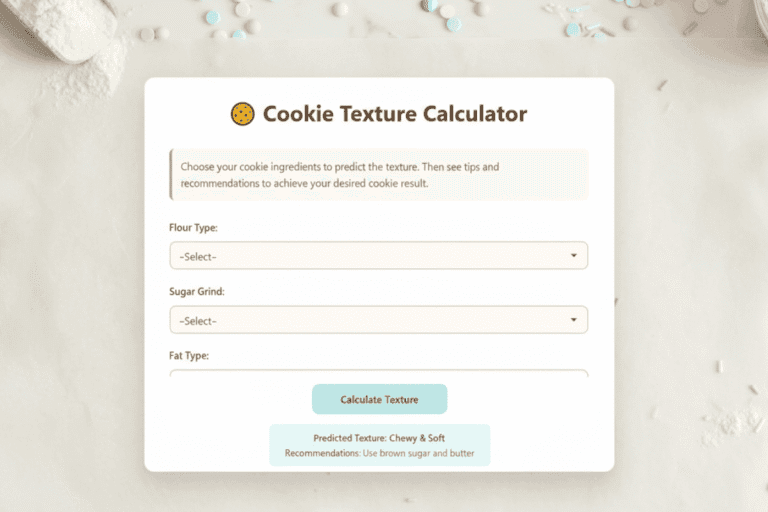
💡 Pro Tip: You can also use our Cookie Texture Calculator to understand how ingredient ratios (like flour, sugar, and fat) affect how your cookies turn out — soft, chewy, or crisp.
This converter uses verified grams-per-cup density data from standard baking measurements, giving you professional-level precision at home — no math or scale required.
Common Cup-to-Gram Conversions for Popular Baking Ingredients
When baking, every ingredient behaves differently — some are light and airy, others dense and heavy. That’s why “1 cup” can vary dramatically between flour, sugar, and butter. Use this quick cups to grams chart as a reliable reference for your recipes.
| Ingredient | 1 Cup (Grams) | Notes |
| 🌾 All-Purpose Flour | 120 g | Spoon & level — never scoop directly from the bag. |
| 🍬 Granulated Sugar | 200 g | Fill evenly and avoid compacting. |
| 🍯 Brown Sugar (packed) | 220 g | Firmly packed into the cup. |
| 🧈 Butter | 227 g | One stick = ½ cup. Softened, not melted. |
| 🥛 Milk | 240 g | Standard liquid conversion (same for whole or 2%). |
| 🍯 Honey | 340 g | Heavier due to higher density and viscosity. |
💡 Pro Tip: You can use our Cups ↔ Grams Converter above to check ingredient-specific values for over 200 baking items — from almond flour to maple syrup — customized for precision.
Values may vary slightly depending on humidity, ingredient brand, and measuring method. Always use the spoon-and-level technique for dry ingredients and a digital scale for best results.
Tips for Accurate Measurements
After spending over 17 years in the baking industry, one lesson stands out above all — accuracy matters more than creativity when it comes to consistent results. Baking is not guesswork; it’s chemistry. Even a small measuring error can throw off the entire balance of flavor and texture.
🥄 Spoon & Level Flour
Never scoop flour directly from the bag — it compacts and adds up to 20% more flour than intended. Instead, spoon it lightly into the cup and level it off with a knife.
🍯 Pack Brown Sugar Firmly
Brown sugar behaves differently from granulated sugar — always pack it tightly into the cup until it holds its shape when turned out.
🥛 Weigh Liquids on a Scale
Liquids expand or contract depending on temperature. Measuring by weight (not volume) ensures consistency, especially for dairy, honey, and oil.
🥣 Avoid Using One Cup for All Ingredients
Dry and liquid measuring cups aren’t interchangeable. Use flat-top cups for dry ingredients and transparent jugs for liquids.
⚙️ Use a Digital Kitchen Scale
A digital kitchen scale is your most powerful baking companion. It eliminates guesswork and ensures every recipe is balanced with professional precision.
👉 You can check out a recommended digital kitchen scale here.
My Real Baking Story
One day, while developing a new cookie formula in the R&D Lab, I learned this lesson the hard way. I was weighing a flavor ingredient to 0.5 gram, but my digital scale rounded it to 1 gram — double the intended amount. I added it anyway, trusting the display.
The result?
A whole batch of perfectly baked cookies that looked great — but tasted unpleasant and bitter. That half-gram difference completely changed the flavor balance.
Since that day, I’ve never taken measurement precision lightly. Even a small inaccuracy can mean the difference between a bakery masterpiece and a disappointing batch.
💡 Pro Insight: Whether you’re baking at home or in a commercial kitchen, always rely on precise, calibrated tools. Accuracy is what separates good cookies from exceptional ones.
FAQs About Cups and Grams in Baking
Baking conversions can feel confusing — especially when one cup of flour doesn’t weigh the same as one cup of sugar or butter. Here are some of the most common questions bakers ask, answered clearly based on ingredient science and real-world experience.
How many grams are in 1 cup?
A: It depends entirely on the ingredient. For example:
1 cup all-purpose flour ≈ 120 g
1 cup granulated sugar ≈ 200 g
1 cup butter ≈ 227 g Each ingredient has a unique density, which affects its weight.
Is 1 cup always 240 grams?
No — only water, milk, and similar liquids measure close to 240 grams per cup. Dry ingredients vary because they trap air differently, depending on how they’re packed or sifted.
How many grams is 1 cup of butter?
Exactly 227 grams, which equals two standard sticks of butter in the U.S. This measurement is universal for solid butter at room temperature.
What’s the easiest way to convert cups to grams?
Use our interactive Cups ↔ Grams Converter above — it automatically adjusts based on the selected ingredient. Just pick your ingredient, enter an amount, and it instantly calculates the accurate weight.
Why do recipes vary in conversion charts?
Slight differences occur due to:
Ingredient brand and grind size
Moisture content (especially in flour and sugar)
Whether the ingredient is packed, scooped, or sifted
That’s why professional bakers prefer weighing ingredients for consistent, predictable results.
Final Thoughts
In baking, precision is everything. While cups are convenient, using grams instead of cups ensures consistency, reliability, and truly bakery-quality results — every single time.
That’s why I created this Cups ↔ Grams Converter — to help home bakers, professionals, and students bake confidently without second-guessing measurements. Whether you’re making chewy cookies, fluffy cakes, or creamy desserts, this converter gives you instant, ingredient-specific accuracy.
💡 Pro Tip: Bookmark this page so you can come back anytime you need quick conversions.
References
- National Institute of Standards & Technology (NIST) – Culinary Measurement Tips
https://www.nist.gov/pml/owm/culinary-measurement-tips - CK-12 Foundation – Introductory Chemistry (Section 12.6: Mass-Volume Stoichiometry)
https://chem.libretexts.org/Bookshelves/Introductory_Chemistry/Introductory_Chemistry_(CK-12)/12%3A_Stoichiometry/12.06%3A_Mass-Volume_Stoichiometry - U.S. Food & Drug Administration (FDA) – Guidelines for Determining Metric Equivalents of Household Measures
https://www.fda.gov/regulatory-information/search-fda-guidance-documents/guidance-industry-guidelines-determining-metric-equivalents-household-measures - King Arthur Baking Company – Ingredient Weight Chart (Professional Reference)
https://www.kingarthurbaking.com/learn/ingredient-weight-chart - USDA FoodData Central – Ingredient Density Database
https://fdc.nal.usda.gov/
Explore More Tools
You can also explore my other free baking tools for more precision and creativity in your kitchen:
If this tool helped you, don’t forget to share it with fellow bakers or pin it on Pinterest — it’s the easiest way to spread good baking science!