⚖️ Butter Cups ↔ Grams Converter
1 cup butter ≈ 227 g.
Note: Melted butter weighs slightly less because air pockets disappear during melting.
Butter might look simple, but its volume can change dramatically depending on the brand, fat content, temperature, and even whether it’s measured in whole sticks, chopped pieces, or softened form. This is why “1 cup of butter” is never as exact as it sounds and why bakers who care about consistency always rely on grams instead of cups.
As a baking professional with 17 years of hands-on industry experience, I’ve learned that even a small variation in butter weight can affect texture, spread, richness, and overall baking performance. To make your recipes more accurate and stress-free, I’ve created this Butter Cups to Grams Converter, designed to give you precise measurements instantly using standard solid stick-style butter density.
This tool helps home bakers and professionals ensure ingredient accuracy, improve results, and eliminate guesswork when measuring dairy fats in recipes.
What Is the Standard Cup-to-Gram Conversion for Butter?
🥣 Standard Measurement:
In baking, 1 cup of solid, stick-style butter = 227 grams.
This is the universally accepted standard used in professional kitchens, bakeries, and R&D labs because it delivers consistent results across recipes.
Why 227 g Is the Standard (Expert Insight)
✔ Butter sticks are pre-measured — In many countries, a standard stick of butter weighs 113.5 g, so two sticks equal 227 g (1 cup).
✔ Reliable density — Solid butter has a stable density compared to melted or whipped butter.
✔ Professional precision — In commercial baking, 227 g per cup is used to maintain consistent fat ratios, dough structure, and spread control.
Why the Weight Changes With Melted or Softened Butter
When butter melts, the air trapped in the solid structure escapes, reducing its volume.
So while 1 cup solid butter = 227 g, the same 227 g of melted butter will no longer fill a full cup it will measure closer to ¾ cup.
This is why recipes always specify:
“1 cup melted butter” vs “1 cup butter”
they are not interchangeable without converting by weight.
International Differences You Should Know
Not all countries use the same cup size:
🌎 US cup = 240 ml
🇦🇺 Australian cup = 250 ml
🇬🇧 UK recipes often use grams or ounces, not cups
If you use the wrong cup size, your butter measurement can be off by 10–20%.
Using grams eliminates this problem entirely.
Why Converting Butter Cups to Grams Matters in Baking
🧈 Butter is one of the most sensitive ingredients in baking — it directly affects spread, texture, moisture, and overall structure of cookies, cakes, and pastries. This means even a small measurement error can dramatically change the final result.
Why Precision Matters
- Butter controls spread: Too much butter → cookies spread thin and greasy. Too little → cookies stay thick and dry.
- It affects structure: Butter aerates during creaming, creating lift. Incorrect amounts change volume.
- Moisture balance shifts: Butter is 80–82% fat and 16–18% water. A small error disrupts the fat-to-dry ratio.
- Different forms = different weights: Chopped, softened, melted, or whipped butter all occupy different volumes.
This is why the same “1 cup of butter” can vary drastically depending on:
- how tightly it’s packed
- whether it’s chopped or whole
- temperature (cold vs softened vs melted)
Why Grams Solve These Problems
Weighing butter in grams eliminates the biggest sources of error:
✔ No air gaps
✔ No uneven chopping
✔ No soft vs firm butter issues
✔ No guessing how tightly to pack
✔ No cup size differences (US vs AUS)
227 grams becomes the precise standard every time ensuring predictable spreads, textures, and baking performance.
A Real Example From My 17 Years in Baking
During one of my R&D lab trials, I tested a butter-heavy cookie formula. The digital scale I used had a tiny rounding issue — it displayed 1 gram instead of 0.5 grams for a butter-based flavor compound.
That tiny half-gram difference might seem small, but in a controlled recipe, it completely changed the flavor profile. The batch turned bitter and unusable.
That day reinforced one truth I share with every baker:
👉 In baking, precision isn’t optional — it’s everything.
Butter is one of the ingredients where this precision matters most.
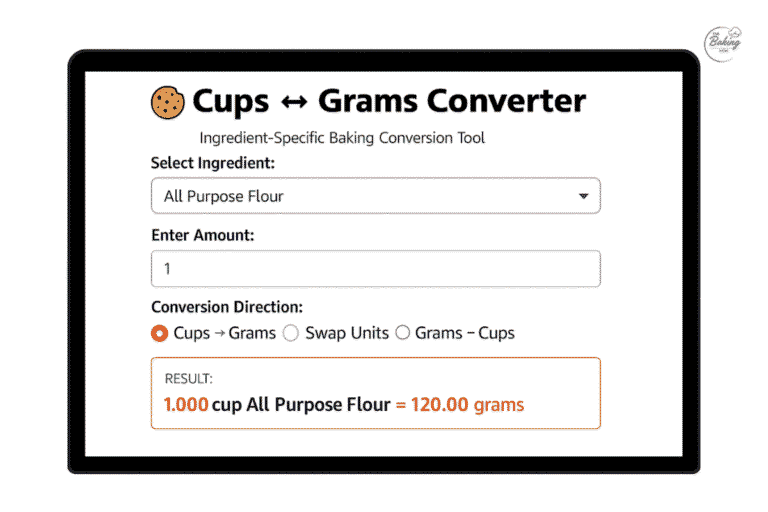
How to Use the Butter Cups ↔ Grams Converter
Using this calculator is simple — and it ensures your butter measurements are accurate every single time. Whether you’re converting cups for a cookie recipe or grams for a cake formula, the tool handles everything instantly.
Step-by-Step Instructions
- Enter the amount of butter
Type the value you want to convert — for example, 1 cup, ½ cup, or 100 grams. - Choose your direction
- Cups → Grams if you’re using a recipe written in cups
- Grams → Cups if your recipe uses metric measurements
- Cups → Grams if you’re using a recipe written in cups
- Click “Convert”
The tool calculates the exact weight or volume automatically. - Use the Swap Units Button
If you want to switch directions, simply press ↻ Swap Units — your input value will update instantly. - Check the Butter Type Note
The converter always uses the standard baking value for solid, stick-style butter (1 cup = 227 g).
This ensures professional-level accuracy, no matter the brand or temperature.
Helpful Tips for Best Results
- Use solid butter values — melted butter weighs less because air escapes.
- Use a kitchen scale if possible, especially for large batches.
- If your butter is very cold or very soft, use grams for the most consistent baking results.
This tool removes all the guesswork, helping you follow recipes correctly and avoid under- or over-buttered results.
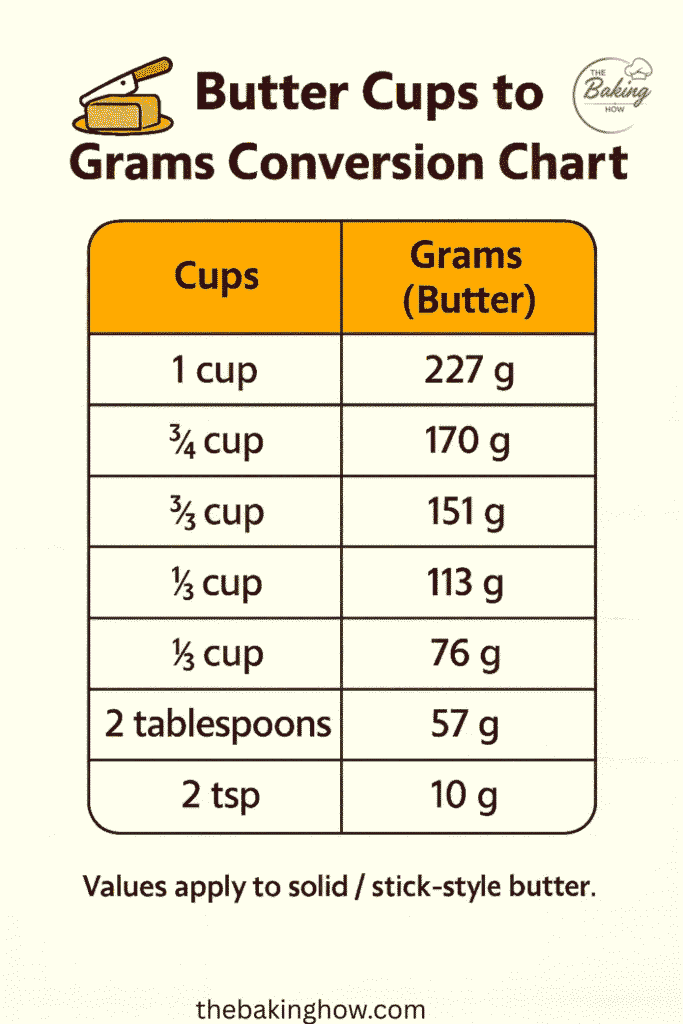
Butter Cups to Grams Conversion Chart
Below is a quick-reference chart for the most common butter conversions used in baking. All values apply to solid, stick-style butter, which weighs 227 g per cup.
| 🧈 Cups (Butter) | 📏 Grams (Butter) |
| 1 cup | 227 g |
| ¾ cup | 170 g |
| ⅔ cup | 151 g |
| ½ cup | 113 g |
| ⅓ cup | 76 g |
| ¼ cup | 57 g |
| 2 tbsp | 28 g |
Why These Values Matter
- 🧈 Butter density stays consistent when solid.
- 📏 227 g per cup is the standard used in professional baking.
- 🍪 Ensures consistent spread, texture, and structure in cookies and cakes.
If you need exact conversions for unusual amounts (like 0.3 cups or 142 g), scroll up and use the Butter Cups ↔ Grams Converter for instant results.
Types of Butter & Why They Change the Weight
Not all butter behaves the same — and its physical state can change the weight per cup. Understanding these differences helps bakers avoid measurement errors and maintain perfect texture, spread, and flavor.
🧈 Solid Stick-Style Butter (Standard — 227 g per cup)
This is the default for baking conversions.
- Used in American stick butter (½ cup = 113 g per stick)
- Contains small air pockets that stay trapped when cold
- Most baking recipes and professional kitchens rely on this standard
🔥 Melted Butter (Weighs Slightly Less)
When butter is melted, the air pockets escape and volume shrinks.
- 1 cup melted butter weighs a bit less than 227 g
- This affects: spread, density, moisture distribution
- Always check whether your recipe calls for melted or solid
☁️ Whipped Butter (Significantly Less Weight Per Cup)
Whipped butter is aerated, so 1 cup contains more air and fewer dairy solids.
- 1 cup whipped butter ≠ 227 g
- Never use whipped butter in baking conversions unless the recipe explicitly calls for it
🇪🇺 European vs 🇺🇸 American Butter (Different Butterfat %)
Butterfat changes richness and structure, but not dramatically the weight per cup.
- European butter: ~82–85% butterfat
- American butter: ~80% butterfat
This affects flavor, browning, and mouthfeel — but 1 cup still averages close to 227 g.
🧂 Salted vs Unsalted Butter
Salt content does not change weight per cup.
- Salted butter may affect flavor and browning
- But grams remain the same
- Professionals prefer unsalted for accuracy in baking chemistry
📘 Quick Takeaway
- Solid, stick-style butter always weighs 227 g per cup
- Melted or whipped butter weighs less per cup
- Butterfat % changes flavor and softness, not grams
- Always check the state of butter before measuring
Tips for Measuring Butter Accurately
Butter is one of the most sensitive ingredients in baking. Even a 10–15 gram difference can change how cookies spread, how cakes rise, and how pastries flake.
Below are practical, bakery-tested tips to help you measure butter with precision.
🧈 Use a Digital Kitchen Scale (Most Accurate Method)
Weighing butter removes all guesswork.
- No air gaps
- No inconsistencies from temperature
- Exact down to the gram
Professionals always weigh butter for reliable texture.
🥣 Avoid Packing Butter Down Too Firmly
If you’re using measuring cups, don’t press butter into them aggressively.
- Packed butter adds extra dairy solids
- This increases weight and alters moisture ratio
Gentle, level scooping works best.
❄️ Keep Butter at the Right Temperature
Butter density changes with temperature.
- Cold = more compact and accurate
- Warm/soft = airy and inconsistent
For accurate cup measurements, butter should be cold or slightly softened, not melted.
🔪 Chop Butter Evenly Before Measuring Cups
Irregular chunks create air gaps.
- Cut butter into small, even pieces
- Add to the cup in layers
- Press very lightly and level the top
This helps get closer to the true 227 g per cup.
📏 Use Stick Markings, but Verify by Weight
Sticks show tablespoon and cup markings, but:
- Factory-cut sticks aren’t always exact
- Wrappers can stretch or shift
Use markings as a guide — then weigh for precision.
🔥 Convert Melted Butter Separately
Melted butter is denser because air escapes.
- 1 cup melted ≠ 1 cup solid
- Always weigh melted butter after melting
This prevents recipe failures from incorrect volume replacement.
📘 Bonus Tip: Match the Recipe’s Butter State
If the recipe says:
- cold butter → don’t melt
- softened butter → don’t chill
- melted butter → don’t use solid
Using the wrong butter state changes texture more than most people realize.
❓ FAQs About Butter Cups and Grams
Q1: How many grams are in 1 cup of butter?
A: 🧈 1 cup of butter = 227 grams when measured as solid, stick-style butter (the standard in U.S. baking).
Q2: Is melted butter the same weight as solid butter?
A:
No. Melted butter loses air pockets, so 1 cup melted butter weighs slightly less than 1 cup solid butter.
Always weigh melted butter after melting for accuracy.
Q3: How many grams is ½ cup butter?
A:
Half a cup of solid butter weighs 113 grams.
Q4: Can I use stick markings instead of weighing?
A:
Yes, you can — one stick equals ½ cup.
But stick markings can shift and aren’t always exact, so weighing is still more accurate, especially for precision baking.
Q5: What butter type does this calculator use?
A:
This tool uses the standard U.S. measurement:
🧈 solid, stick-style butter → 227 g per cup.
This matches professional baking conversions and ensures consistent results.
Final Thoughts
Switching from cups to grams is one of the simplest ways to improve your baking accuracy especially when working with butter. Because butter’s volume can change based on temperature, brand, and texture, using grams removes all the guesswork and gives you the consistency that professional bakers rely on.
If you want more clarity on how butter behaves in baking, especially in cookies, you can read my detailed guide here:
👉 What Does Butter Do in Cookies?
For fast, accurate conversions, you can bookmark this Butter Cups ↔ Grams Converter and explore more precision-focused tools below:
- ⚖️ Quick Baking Converter (grams ↔ cups ↔ ounces)
- 🍪 Cookie Texture Calculator (predict spread, chewiness, crispiness)
- 🧮 All Baking Tools & Calculators
If this butter converter helped you, feel free to share it with fellow bakers or save it on Pinterest — it’s the easiest way to support accurate baking science.
📚 References
These authoritative sources support the measurement accuracy and scientific explanations in this guide (same structure as your Cups→Grams article):
- National Institute of Standards & Technology (NIST) – Culinary Measurement Tips
- U.S. Department of Agriculture (USDA) – Dairy Product Composition Data
U.S. Food & Drug Administration (FDA) – Household Measurement Guidelines