
⚖️ Sugar Cups ↔ Grams Converter
Measuring sugar in baking isn’t as simple as scooping “1 cup.” Sugar volume changes based on granule size, moisture content, and whether it’s granulated, brown, or powdered sugar. For example, granulated sugar grams per cup is typically 200 g, while packed brown sugar weighs more and sifted powdered sugar weighs far less. This variation often leads to inconsistent results — especially in cookies, cakes, and frostings where accurate sugar measurement is critical.
As someone who has worked 17 years in the baking and product development industry, I have seen how even small sugar measurement errors can change sugar weight in baking, affecting sweetness, spread, texture, and browning. That’s why professional bakers always rely on grams, not cups — weight is consistent, precise, and unaffected by how tightly (or loosely) sugar is packed.
To make sugar conversions effortless, I have created this free, baking-optimized Sugar Cups to Grams Converter. It uses ingredient-specific density values such as sucrose crystal weight, packed brown sugar density, and powdered sugar fineness to give you the most accurate conversion possible. Whether you’re scaling a recipe or replacing one sugar type with another, this tool ensures every bake starts with precision.
👉 Scroll down to convert instantly or explore the complete sugar weight guide below.
🧮What Is the Standard Cup-to-Gram Conversion for Sugar?
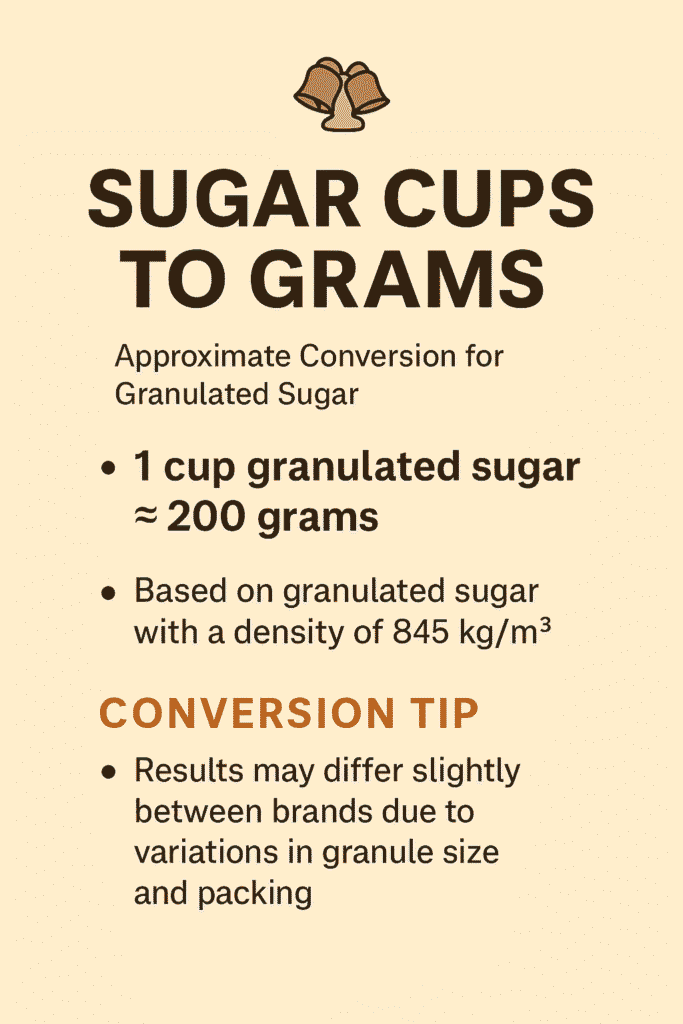
1 cup granulated sugar = 200 grams
(This is the standard U.S. baking measurement.)
But sugar weight changes depending on crystal size, moisture, and compaction, so different sugar types have different gram values per cup:
| Sugar Type | Weight per 1 Cup | Notes |
| Granulated Sugar | 200 g | Standard sucrose crystals, loosely filled |
| Brown Sugar (packed) | 220 g | Higher moisture → compression increases weight |
| Powdered Sugar (sifted) | 120 g | Very fine particles → more air → lighter |
| Powdered Sugar (unsifted) | 160 g | More densely packed |
| Caster Sugar | 190 g | Finer crystal size → slightly heavier than granulated |
🍚 Why Sugar Weights Vary
Sugar isn’t uniform — it behaves differently depending on:
🔹 Crystal Size (Sucrose Structure)
- Granulated sugar has medium-sized crystals → consistent 200 g/cup
- Caster sugar has smaller crystals → packs slightly tighter → ~190 g/cup
🔹 Compaction (How Tightly It’s Packed)
- Brown sugar contains molasses → sticky + high moisture
- This causes compression, which increases density → higher grams per cup
🔹 Powdered Sugar Density
- Very fine → traps air → much lighter when sifted
- Unsifted powdered sugar compresses → heavier
Even slight differences can affect sweetness, cookie spread, browning, and structure — which is why our Sugar Cups to Grams Converter uses precise density values for each sugar type.
Why Converting Sugar Cups to Grams Matters in Baking
Sugar isn’t just sweetness — it’s one of the most structural ingredients in baking. How much sugar you use determines:
- 🍪 Spread (more sugar = wider, thinner cookies)
- 🔥 Browning & caramelization
- 💧 Moisture retention
- 🧁 Tenderness & crumb structure
- 🌡 How fast your dough melts in the oven
Even a difference of 10–20 grams can completely change how cookies or cakes bake.
And that difference happens easily when measuring in cups.
📏 Cups Are Inconsistent — Grams Are Precise
Here’s why:
1. Scooping vs spooning changes the weight
Two bakers scooping from the same sugar container can get totally different amounts in 1 cup.
2. Brown sugar must be packed, which causes huge variations
If you pack too tightly → your cookies become too sweet and spread too much.
If you pack loosely → your dough becomes dry and crumbly.
3. Powdered sugar is even more unpredictable
Sifted? Light.
Unsifted? Heavy.
Tightly scooped? Heavier.
Same “cup,” different weight.
4. Grams remove ALL measurement guesswork
Scales don’t care about air pockets, compression, or scooping style —
They give you accurate baking measurements every single time.
🔥 Short Story From My R&D Baking Experience
A few years ago, during a cookie development trial in the R&D lab, I made two batches using the same recipe — the only difference was how the sugar was measured.
- In Batch A, the assistant scooped the brown sugar loosely.
- In Batch B, they packed the brown sugar too tightly.
Even though both were “1 cup,” Batch B had nearly 30 grams extra sugar.
The result?
- Batch A → balanced, soft cookies
- Batch B → overspread, overly sweet, darker, and greasy
That day confirmed again:
cups vary — grams don’t.
How to Use the Sugar Cups to Grams Converter (Step-by-Step)
Using this converter is simple — and optimized specifically for baking accuracy. Whether you’re working with granulated, brown, or powdered sugar, the tool instantly applies the correct grams-per-cup density for the type of sugar you select.
Follow these quick steps:
✅ 1. Enter the Amount
Type the amount you want to convert —
for example:
- 1 cup, or
- 150 grams
The calculator accepts decimals (e.g., 0.25 cup).
✅ 2. Choose the Direction
Select whether you want to convert:
- Cups → Grams
- Grams → Cups
This tells the tool which formula to apply.
🔄 3. Use the Swap Button (Optional)
Tap ↻ Swap Units to instantly switch direction.
The calculator:
- flips the conversion direction
- auto-updates the numeric value
- keeps the sugar type selected
Perfect for testing reverse conversions quickly.
🧮 4. The Calculator Applies the Correct Sugar Type
Once you select the sugar type (granulated, brown, powdered, caster, etc.):
- each type has its own density
- the tool uses the exact grams-per-cup value for your sugar
- output updates instantly using the baking-correct formula
This ensures your measurements match professional baking standards.
🎯 5. Get Your Baking-Optimized Result
The result box displays:
- the converted value
- optimized decimal rounding
- a helpful baking note (e.g., “packed brown sugar is heavier”)
Ideal for ensuring precise dough texture and consistent outcomes.
Sugar Cups to Grams Conversion Chart
Below is the essential cups → grams chart for granulated sugar, based on standard U.S. baking measurements. These values help ensure accurate sweetness, correct cookie spread, and consistent texture — especially when scaling recipes.
🍬 Granulated Sugar Conversion Table
| Cups | Grams |
| 1 cup | 200 g |
| ¾ cup | 150 g |
| ⅔ cup | 134 g |
| ½ cup | 100 g |
| ⅓ cup | 67 g |
| ¼ cup | 50 g |
| 2 tbsp | 25 g |
| 1 tbsp | 12.5 g |
📝 Note:
This chart applies only to granulated sugar.
Other sugars have different densities:
- Brown sugar (packed): ≈ 220 g per cup
- Powdered sugar (sifted): ≈ 120 g per cup
- Caster sugar: ≈ 190 g per cup
- Powdered sugar (unsifted): ≈ 160 g per cup
Always choose the correct sugar type for accurate conversions.
Types of Sugar & How They Change the Weight
Not all sugars weigh the same. Their crystal size, moisture content, and level of compaction dramatically change how many grams fit into a cup. Understanding these differences is essential for baking accuracy, texture control, and recipe consistency.
Here’s how each sugar type behaves — and why it weighs differently.
🍬Granulated Sugar (Standard: 200 g per cup)
Granulated sugar is the baseline sugar used in most baking conversions.
- Medium, uniform sucrose crystal size
- Flows freely → minimal compaction
- Reliable for measuring with spoon-and-level
- Ideal for cookies, cakes, quick breads
Because of its consistent density, 1 cup = 200 g is the industry standard.
Best for: everyday baking, general sweetening, aeration during creaming.
🍯Brown Sugar (Packed — 220 g per cup)
Brown sugar is heavier because it contains molasses, which increases moisture content and density.
Why it weighs more:
- Sticky molasses coats each granule → denser pack
- MUST be pressed firmly (packed) into the cup
- Holds shape when flipped out
- Adds moisture, chewiness, and deeper caramel flavor
Standard weight:
- 1 cup packed brown sugar = 220 g
Best for: chewy cookies, moist cakes, caramel-like bakes.
❄️Powdered / Confectioners’ Sugar
Powdered sugar is finely ground into a soft powder and often contains a small amount of cornstarch. The weight depends heavily on whether it’s sifted.
- Sifted powdered sugar: ~120 g per cup
- Unsifted powdered sugar: ~160 g per cup
- Very light → extreme aeration
- Compresses easily → major weight differences
Best for: frosting, icing, dusting, buttercream.
🍚Caster / Extra-Fine Sugar — 190 g per cup
Caster sugar has smaller crystals than granulated sugar, giving it a slightly lower density.
- Dissolves faster
- Helps avoid grainy textures
- Wonderful for whipping with butter or egg whites
Standard weight:
- 1 cup caster sugar ≈ 190 g
Best for: meringues, delicate cakes, fine-texture cookies.
🧠 Why These Differences Matter
Sugar types change:
- density
- compaction level
- moisture content
- crystal structure
This impacts sweetness, spread, caramelization, and texture in your baked goods.
Tips for Measuring Sugar Accurately
Sugar plays a major role in sweetness, browning, spread, moisture, and texture. Even small measurement errors can affect how cookies flatten, how cakes rise, or how caramel sets. These practical tips help ensure your sugar measurements stay precise and consistent every time.
✅ 1. Always Weigh Sugar for Maximum Accuracy
A kitchen scale removes all guesswork.
Different sugars pack differently, but grams stay consistent.
🥄 2. Use the Spoon-and-Level Method for Granulated Sugar
Never scoop directly from the bag — that compacts sugar and adds extra weight.
Instead:
- Spoon sugar into the cup
- Level with a straight edge
This prevents overfilling by 10–20g.
🍯 3. Pack Brown Sugar Firmly
Brown sugar must be pressed tightly into the cup until it holds its shape.
Loose brown sugar can under-measure by up to 30g.
❄️ 4. Sift Powdered Sugar Before Measuring
Powdered sugar traps air and clumps easily.
- Sift → measure for accuracy
- OR weigh directly in grams (best option)
This prevents overly sweet or dense frosting.
🚫 5. Don’t Scoop Sugar Directly with a Measuring Cup
Scooping compresses sugar crystals and adds weight.
Especially problematic for:
- powdered sugar
- brown sugar
- caster sugar
Use spoon-and-level or weigh instead.
🌡️ 6. Store Sugar Properly to Prevent Moisture Changes
Humidity affects sugar density:
- Brown sugar hardens
- Powdered sugar clumps
- Granulated sugar becomes heavier
Store in airtight containers for consistent measurements.
📏 7. Use Weight When Scaling Recipes
When doubling or halving recipes, grams scale perfectly — cups do not.
🍪 8. Match the Sugar Type Exactly
Different sugar types = different densities.
Never substitute granulated, brown, caster, or powdered sugar without adjusting weight.
FAQs About Sugar Cups and Grams
These are the most common questions bakers ask when converting sugar between cups and grams.
Q1: How many grams are in 1 cup of sugar?
✔️ A: 1 cup of granulated sugar = 200 grams.
This is the standard weight used in U.S. and professional baking.
Q2: Is brown sugar heavier than white sugar?
✔️ A: Yes.
Because brown sugar contains molasses and must be packed,
1 cup packed brown sugar ≈ 220 grams, making it denser than granulated sugar.
Q3: How many grams is ½ cup of sugar?
✔️ A: ½ cup granulated sugar = 100 grams.
Q4: Is powdered sugar the same weight as granulated sugar?
✔️ A: No. Powdered (confectioners’) sugar is much lighter because it contains more air.
Sifted powdered sugar: ~120 g per cup
Unsifted powdered sugar: ~160 g per cup
This is why frosting and icing recipes always recommend sifting.
Q5: What sugar type does this calculator use?
✔️ A: The calculator uses granulated sugar by default, but you’ll be able to switch to brown sugar, powdered sugar, or caster sugar depending on your recipe.
Final Thoughts
Converting sugar from cups to grams may seem small, but it makes a big difference in baking. When you measure sugar by weight, you remove all the guesswork caused by:
- different scoop styles
- packed vs unpacked sugar
- crystal size
- humidity and moisture changes
Using grams gives you consistent, bakery-quality cookies, cakes, and desserts every time — especially when working with sensitive recipes like meringues, brownies, and butter cookies.
To make your baking even easier, bookmark this Sugar Cups ↔ Grams Converter and keep it handy for your next recipe. And if you want to dive deeper into baking science, explore my other free tools and guides:
- ⚖️ Quick Baking Converter – Convert grams ↔ cups ↔ ounces instantly
- 🍪 Cookie Texture Calculator – Predict whether cookies will be chewy, soft, or crispy
- 🍯 Brown Sugar vs White Sugar in Cookies? – How each one changes texture & spread
- 🧮 Cups to Grams Converter (All Ingredients) – 200+ ingredient-specific conversions
If this tool helped you, share it with fellow bakers or save it to Pinterest — it’s one of the easiest ways to support The Baking How and spread good baking science.
📚 References
To ensure accuracy, all sugar weight conversions and measurement principles in this guide are based on verified, authoritative sources:
- National Institute of Standards & Technology (NIST) — Culinary Measurement & Density Guidelines
- United States Department of Agriculture (USDA) — FoodData Central: Sugar, Brown, Granulated, Powdered
- CK-12 Foundation — Chemistry: Mass–Volume Relationships
- U.S. Food & Drug Administration (FDA) — Guidelines for Determining Metric Equivalents of Household Measures
